
Aceh – Indonesia, Aceh was once home to a number of literary masters. Their works even enriched the Indonesian literary universe. Efforts to reintroduce Aceh’s literary wealth to the younger generation were carried out through the Aceh Literary Feast 2026, organized by Sophie’s Sunset Library with support from the Directorate of Digital Cultural Development under the Indonesian Ministry of Culture.
Held from September 12 to September 27, 2026, the event showcased a diverse array of literary works, spanning from 16th-century classical literature to contemporary Acehnese literature. An exhibition showcasing the works and archives of literary figure Ali Hasjmy was also held at the Ali Hasjmy Museum and Library.
Event coordinator and co-founder of Sophie’s Sunset Library, Raihan Lubis, stated that the Aceh Literary Feast 2026 was expected to serve as a meeting point for literary and literacy activists in Aceh.
“The Aceh Literary Feast 2026 is expected to serve as a meeting space for literary and literacy activists in Aceh to connect and network. Thus, communities are hoped to mutually support the strengthening and development of literary and literacy communities,” said Raihan Lubis in a statement on Monday, September 28, 2026.
According to him, such events must continue to be held to revive and broadcast Acehnese literary works so they can be recognized by today’s generation. “It is also hoped that many of the finest literary works will be born from Aceh,” he added.
Bringing Literary and Literacy Communities Together
The Aceh Literary Feast 2026 also featured a community space involving administrators and founders of several literacy communities in Aceh.
Among them were Aceh Book Party, Rak Baca T36, Sisi Buku, and Jual Buku Aceh, representing indie bookstore owners in Banda Aceh. Artists from various backgrounds were also invited to share their experiences.
The event kicked off with a short story writing workshop featuring Ida Fitri, marking the opening of the Aceh Literary Feast 2026.
Ida Fitri is a short story writer and novelist from Bireuen. In 2023, she won third place in the Jakarta Arts Council Novel Competition. Last year, her work made it to the shortlist of the Kusala Sastra Khatulistiwa, the most prestigious literary award in Indonesia.
In the workshop attended by more than 40 participants, Ida Fitri shared her experience in crafting short stories that achieved national publication and acclaim.
“I sincerely hope this event can spark interest among participants, especially Aceh’s youth, to create short stories that gain recognition,” she said. A graphic literature workshop was also held to respond to several works by Acehnese authors.
The activity blended lines and colors with short stories centered on local themes. It aimed not only to discover young talent in creating literary illustrations, but also to encourage youth to become more familiar with existing local literature.
The graphic literature workshop was led by Idrus bin Harun from the Kanot Bu ecosystem, Banda Aceh.
Reading Acehnese Literature from a Contemporary Perspective
The Aceh Literary Feast 2026 also held discussions on winning books from the Kusala Sastra Khatulistiwa 2026.
The two literary works discussed were a novel by Nukila Amal titled “Ikhtiar yang Tak Benar-benar” and a short story collection by Ratri Ninditya titled “Hantu Ulang-alik”.
Community space activities were also arranged so literacy and literary communities could share experiences in building their respective organizations.
16th-century literary works, such as the classical book Bustanussalatin by Syekh Nurruddin Ar-raniry and Hikayat Pocut Muhammad, were discussed from a contemporary perspective.
Bustanussalatin, which features a chapter discussing city gardens or royal parks, was analyzed through the lens of modern public spaces in Banda Aceh, guided by Professor Cut Dewi from Syiah Kuala University (USK). This discussion took place at Taman Sari Bustanussalatin.
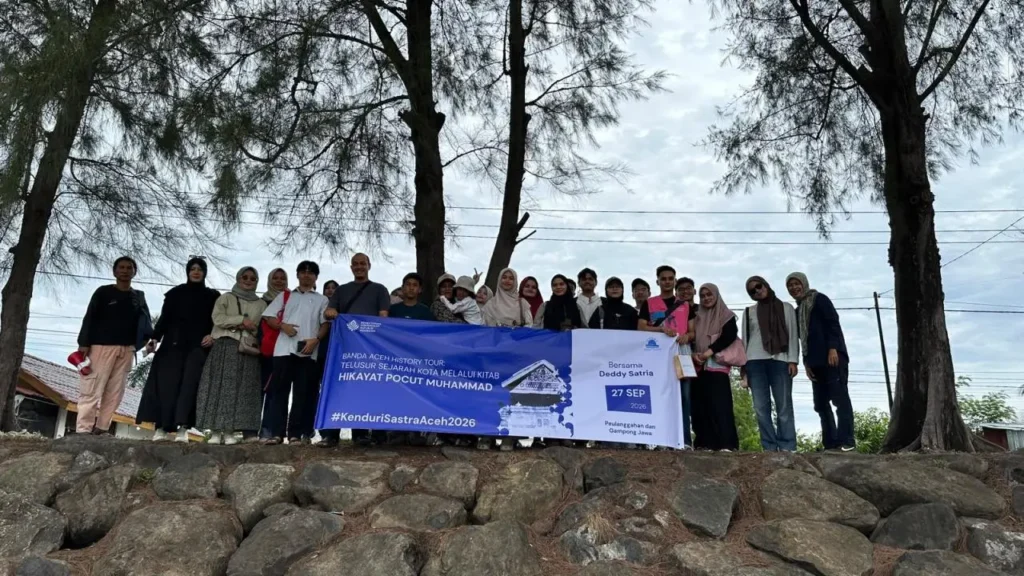
Meanwhile, Hikayat Pocut Muhammad was discussed during a walking tour in the Peulanggahan and Gampong Jawa areas, where the stories of war and power struggles historically took place. The tour was led by archaeologist Deddy Satria.
Sophie’s Sunset Library, as one of the literacy communities in Aceh, continuously strives to remain consistent in organizing literacy- and literature-based events.
“We hope these activities can serve as a catalyst for cross-sector collaboration and community partnerships to maintain the literary ecosystem in Aceh. We also hope to further encourage activists so they can showcase their talents nationally and internationally,” said the Head of the Aceh Language Center, Muhammad Irsan, during a community space event held at the courtyard of Sophie’s Sunset Library in the Geuceu Komplek area, Banda Aceh.
Exhibition of Works and Archives of Ali Hasjmy
The highlight of the Aceh Literary Feast 2026 was marked by an exhibition of works and archives belonging to Ali Hasjmy. The Acehnese literary figure was also an academic, scholar, and politician. He authored dozens of books, ranging from religious texts to poetry collections and novels.
The exhibition also featured poetry readings by L.K. Ara and Vandols, as well as a public discussion featuring Professor Syabuddin Gade from UIN Ar-Raniry, who wrote a book on Ali Hasjmy; researcher Mirza Ardi, who has extensively reviewed Ali Hasjmy’s works; and Mohammad Iqbal Bharata, M.T., representing Ali Hasjmy’s family.
The public discussion held in the backyard of the Ali Hasjmy Museum and Library drew significant attention from various circles, including the youth of Banda Aceh.
Moderated by Raihan Lubis, the discussion did not merely cover Ali Hasjmy’s works, but also invited participants to revisit and re-read those works in a modern context.
“This event is expected to engage the public in conversations about Ali Hasjmy, ensuring that the community and youth learn about his ideas, which remain relevant today,” Syabuddin said.
He expressed hope that the public would re-engage with Ali Hasjmy’s works, thoughts, and intellectual legacy. “Not merely to remember, but to re-read, question, and discover new meaning in a contemporary context,” he stated.