
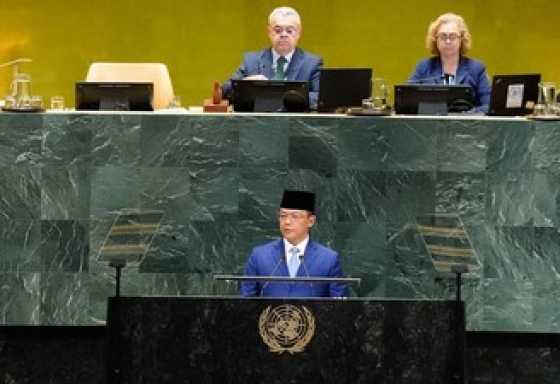
NEW YORK — Indonesian Minister of Foreign Affairs Sugiono urged the United Nations (UN) to transform to become more representative, agile, and capable of taking action in the face of various global challenges.
Sugiono stated that these reforms are essential to strengthening the multilateral system amid the world’s various ongoing crises. According to him, the solution to the shortcomings of the multilateral system is not to diminish the role of multilateralism, but to build a stronger system that can function more effectively.
“The answer to imperfect multilateralism is not less multilateralism. The answer is stronger and better multilateralism,” Sugiono said in his address at the 81st UN General Assembly in New York, US, on Saturday, September 26, 2026, local time.
He emphasized that a multilateral system suited to the needs of the 21st century must be more representative, more agile, and better equipped to deliver action.
Although institutional reform cannot happen overnight, Sugiono stressed that the urgency of current challenges demands immediate action.
“Institutional transformation will not happen overnight. However, the urgency of today’s challenges requires us to act now,” he said.
Sugiono underscored the continued importance of the UN as an institution that provides space for nations to resolve differences without conflict, establish shared rules when state leaders make announcements, and pool resources when a nation cannot act alone.
Therefore, according to Sugiono, trust in the UN must be accompanied by reform so that the institution can adapt to global developments.
Furthermore, strengthening the multilateral system must begin by enhancing collective capabilities to address crises, respond to global humanitarian situations, and safeguard peace, development, and cooperation.
He also highlighted the international financial architecture, which he believes needs to evolve to better address the needs of developing nations.
Such changes, Sugiono noted, are crucial so that developing countries have greater space to define their development priorities and strengthen their respective resilience.
However, Sugiono cautioned that institutional strengthening alone is not enough. He stressed that international law must be applied consistently, respected, and colonialism must end.
“Institutions only uphold the principles we are willing to uphold. International law must be enforced consistently. Sovereignty must be respected, and colonialism must be ended,” Sugiono stated.
In his speech, Sugiono then connected these principles to the issue of Palestine. He described Palestine as one of the clearest tests of the principles underpinning the multilateral system, as well as a test of the world’s conscience.
According to Sugiono, violations of international law in Gaza and the West Bank are reminiscent of world conditions prior to 1945, before the birth of the UN Charter, the Universal Declaration of Human Rights, and the four 1949 Geneva Conventions.
Sugiono stated that Indonesia’s own history of fighting for independence from colonialism shapes its support for the Palestinian people and their right to self-determination.
Indonesia, he added, will continue to stand with the Palestinian people until their right to self-determination is fulfilled and an independent, sovereign Palestinian state is realized based on a two-state solution, in accordance with international law and internationally agreed parameters.
“Palestine is not just an issue for one region. Palestine is a test of whether the multilateral system can uphold the principles it set out to defend in the first place, and whether that system can deliver results when it is needed most,” Sugiono said. []